
How Do Overlapping Cron Jobs Quietly Create Double-Processing and Conflicting Writes in the Same System?
1. Introduction: “Nothing Failed… But Data Looks Wrong”
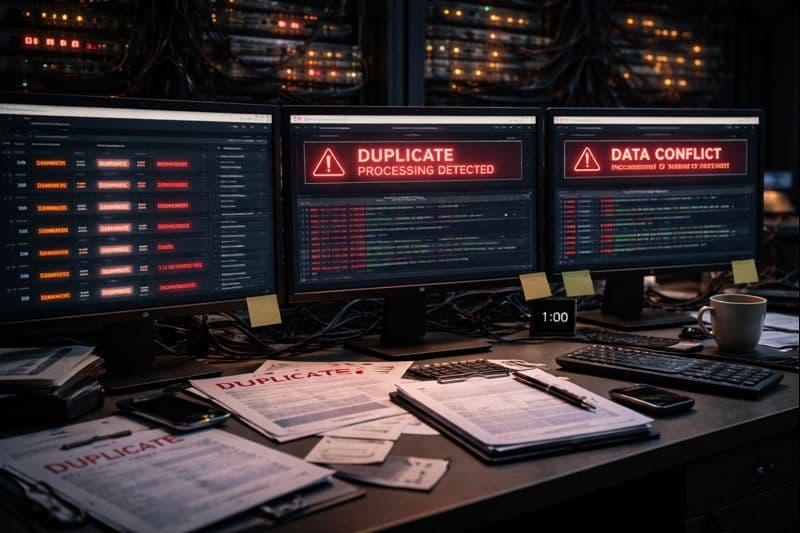
Overlapping cron jobs rarely cause a loud outage.
Instead, you notice slow, expensive symptoms:
- counts drift between dashboards
- the same user gets charged twice (or refunded twice)
- records flip-flop between states
- “already processed” warnings appear randomly
- support tickets spike, but servers look healthy
This is the real pain: the system keeps running, but correctness quietly collapses.
When cron schedules overlap, the problem is not “two jobs ran.”
The problem is that the system has no hard guarantees about:
- exclusive ownership of a dataset
- single execution per item
- consistent ordering of writes
This article explains the most common double-processing patterns, the exact write conflicts they create, and how to detect them early.
2. Why Overlap Happens More Than Teams Expect
2.1 Jobs take longer over time
A job that used to finish in 2 minutes now takes 9:
- data volume grows
- dependencies slow down
- retries increase
- a new feature adds extra queries
If the schedule stays the same, overlap becomes inevitable.
2.2 “Retry + timeout” creates hidden overlap
Even if schedules don’t collide, overlap can happen when:
- a job worker stalls but doesn’t die
- the scheduler retries a “stuck” run
- both runs continue
Now you have two active runs with the same intent.
2.3 Different jobs overlap on the same rows
Even if they are different cron jobs, overlap matters if:
- both touch the same table
- both write to the same “status” fields
- both update the same aggregates
Conflict is about data, not job names.
3. The Quiet Failure Modes You Actually Get
3.1 Duplicate processing of the same items
Classic pattern:
- Job A scans “pending” items
- Job A starts processing item X
- Job B starts before Job A commits status updates
- Job B also sees item X as pending
- both process X
Concrete outcomes:
- duplicate charges or payouts
- duplicate emails/notifications
- two exports for one dataset
- inventory decremented twice
Why it happens:
- selecting work is not atomic with claiming work
3.2 Conflicting writes: last writer wins, but reality loses
Two job runs update the same row differently:
- one marks “completed”
- another marks “failed” and schedules retry
- another updates “next_run_at” based on old state
Outcome:
- the record ends up in the wrong state
- the next job run behaves incorrectly
- engineers see “impossible transitions”
This is worse than duplicates because it corrupts the state machine.
3.3 Double aggregation and drifting counters
Jobs that compute aggregates (daily totals, leaderboards, billing summaries) are vulnerable.
If two runs both “add today’s events”:
- totals double
- later correction scripts fight each other
- finance and product dashboards diverge
Even if you “overwrite totals,” overlap can still break correctness if:
- the inputs differ by time window
- one run reads partial data
- one run finishes later and overwrites newer truth
3.4 Partial work + compensation creates more writes
Many cron jobs do:
- process N items
- commit partial progress
- continue
If overlap happens mid-run:
- both runs create compensating tasks
- retries multiply
- queue depth increases
- you get a correctness + cost incident
4. The Two Root Causes Behind Most Overlap Bugs
4.1 No locking strategy
If there is no:
- global job lock
- partition lock
- per-item lock
Then overlap is not an accident. It is guaranteed eventually.
4.2 No idempotency boundary
If “doing the work twice” has different effects than “doing it once,” you need idempotency:
- unique keys
- de-dup tokens
- idempotent writes
- exactly-once semantics at the right boundary
Without that, overlap always becomes double-processing.
5. Easy Detection: What to Log and Alert On
5.1 Run-level visibility
Log per run:
- job_name
- run_id
- scheduled_time vs start_time
- end_time
- status (success/fail/partial)
- items_claimed / items_processed
Alert:
- run duration approaching schedule interval
- concurrent runs with the same job_name
5.2 Item-level uniqueness
Track:
- “attempt count” per item
- “processed_at” timestamps
- dedup hits (how often you prevent duplicates)
Alert:
- same item processed twice within a window
- attempt spikes correlated with scheduler retries
5.3 State transition sanity
Log state transitions explicitly:
- old_state → new_state
- actor (job_name/run_id)
- reason
Alert:
- invalid transitions (completed → pending)
- flip-flopping within short windows
6. Fixes That Actually Work (Not Just “Run It Less Often”)
6.1 Add a job-level lock (the simplest baseline)
Use a distributed lock:
- Redis
- DB advisory lock
- Zookeeper/etcd
Rule:
- if lock is held, the new run exits immediately
This prevents “same job overlap,” but not conflicts between different jobs.
6.2 Partition the dataset and lock per partition
Instead of one global job, split by:
- tenant_id
- region
- hash bucket
- date shard
Then apply:
- lock per partition
- independent retries per partition
This scales and reduces blast radius.
6.3 Make “claiming work” atomic
Do not:
- SELECT pending rows
- then UPDATE them later
Do:
- UPDATE … WHERE status=’pending’ LIMIT N RETURNING rows
- or SELECT … FOR UPDATE SKIP LOCKED
Goal:
- one runner claims the work
- others cannot see it as pending
This is the single most effective fix for duplicates.
6.4 Build idempotency into writes
Examples:
- use a unique constraint on (job_type, item_id, logical_day)
- store a dedup key and ignore repeats
- make external calls idempotent with request IDs
If jobs overlap, duplicates become no-ops instead of incidents.
6.5 Control retries like a budget, not a reflex
When overlap is caused by slow dependencies, retries make it worse.
Use:
- exponential backoff
- max attempts
- global retry budget per job or per partition
Failing fast is cheaper than silently doubling load.
7. Where YiLu Proxy Helps in Cron-Heavy Systems (When Jobs Rely on External Calls)
A lot of cron jobs are not just DB updates. They call external services:
- payment gateways
- shipping providers
- data collection endpoints
- partner APIs
When those outbound calls are unstable:
- timeouts increase
- retries increase
- job duration grows
- overlap becomes more likely
YiLu Proxy can reduce overlap pressure by making outbound traffic more predictable:
- stable proxy pools for critical external calls, reducing latency variance
- separate pools for bulk jobs vs sensitive operations, preventing exit contention
- controlled IP switching so retries don’t spray across routes and create inconsistent behavior
A practical pattern:
- CRON_CRITICAL_POOL: low concurrency, stable exits, strict retry caps
- CRON_BULK_POOL: high rotation, hard rate caps, drop-on-overload
- never allow bulk pools to borrow critical exits
This doesn’t replace locking or idempotency. It reduces the network-driven jitter that turns “barely fine” schedules into overlapping runs.
Overlapping cron jobs rarely fail loudly. They fail by slowly corrupting correctness.
The common outcomes are predictable:
- duplicate processing
- conflicting writes
- drifting aggregates
- retry storms
The fixes are also predictable:
- locks (job or partition)
- atomic claiming
- idempotent writes
- controlled retries
- run-level and item-level observability
If your jobs are growing over time, overlap is not a rare event. It is a certainty. Design for it before it designs your incident report.